

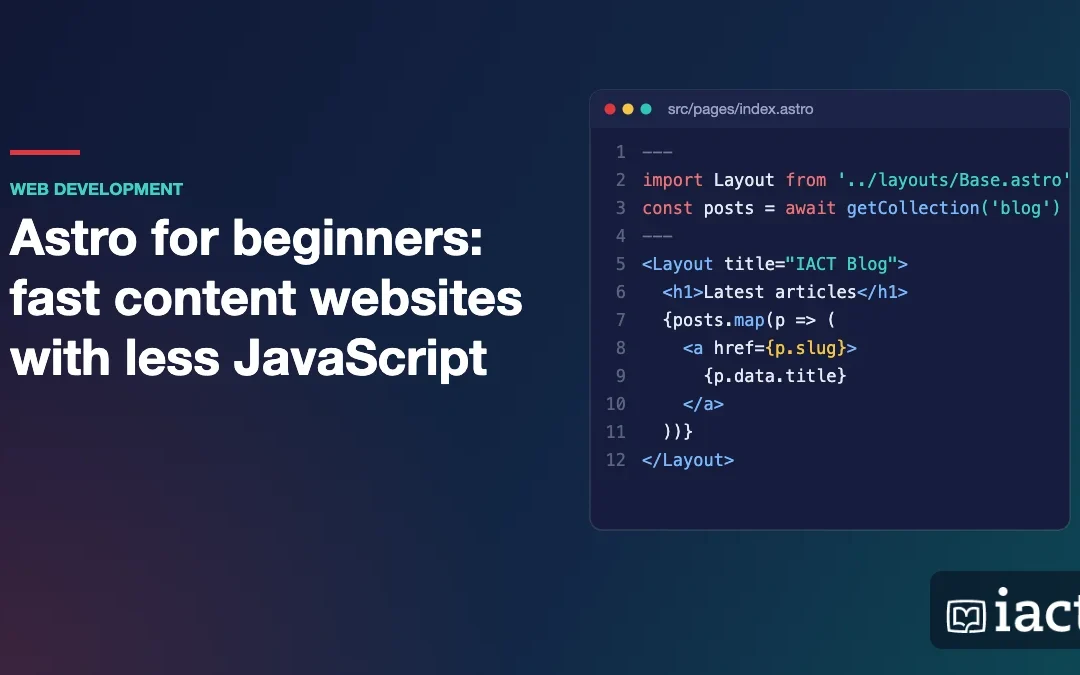
If you have looked at modern web development and found it intimidating – a wall of build tools, JavaScript frameworks and configuration – Astro is the 2026 antidote. It is a framework designed for content-driven sites like blogs, documentation, marketing pages and portfolios, and its whole philosophy is to ship as little JavaScript as possible. For beginners, that means you spend most of your time writing familiar HTML and CSS, and the result is a site that loads fast without you having to optimise it by hand.
Why Astro is beating heavier frameworks for content sites
Frameworks like Next.js are powerful but send a lot of JavaScript to the browser, which can slow down sites that are really just pages of content. Astro takes the opposite approach: it renders your pages to static HTML at build time and includes zero JavaScript by default. The page the visitor downloads is lean and fast. In 2026 this has made Astro the go-to choice for blogs, docs and content sites – and its momentum was strong enough to attract a Cloudflare acquisition, a sign of how seriously the industry is taking it.
The Islands model: interactivity only where you need it
Astro’s signature idea is ‘islands of interactivity’. Most of your page is static HTML, but where you genuinely need something interactive – a search box, an image carousel, a comment widget – you drop in an interactive component, and only that component ships JavaScript. The rest of the page stays static. This is why Astro sites feel instant: the browser is not parsing a huge JavaScript bundle just to show text and images.
Beginner-friendly by design
Astro’s component syntax is close to HTML, so the learning curve is gentle. You can start with plain pages and add complexity only as you need it. It also lets you use components from React, Vue or Svelte if you already know one of those, but you are not required to – a complete beginner can build a real site knowing only HTML, CSS and a little JavaScript. The official documentation is genuinely good and walks you from zero to a deployed site.
Content collections and Markdown
Because Astro is built for content, writing in Markdown is a first-class experience. You can keep your blog posts or docs as simple Markdown files, and Astro’s content collections give them structure and type-safety so you catch mistakes early. For anyone moving from a heavy CMS, the simplicity of ‘a folder of Markdown files becomes a website’ is liberating.
Your first steps
Install Node.js, then create a new project with the official starter and pick a template. Edit a page, see it update instantly in the dev server, and write your first Markdown post. Deploy free to a host like Cloudflare Pages or Netlify in a couple of clicks. Resist the urge to add interactivity everywhere – the discipline of keeping pages static and adding islands sparingly is exactly what keeps your site fast. Build a small portfolio or blog first; it is the quickest way to understand why Astro has won so many developers over.
Key takeaways
- Astro is built for content sites – blogs, docs, portfolios, marketing pages – and ships zero JavaScript by default.
- The 'islands' model adds interactivity only to the specific components that need it, keeping pages fast.
- Its HTML-like syntax makes it genuinely beginner-friendly; you can build real sites with just HTML, CSS and a little JS.
- Markdown and content collections make writing and structuring content simple and type-safe.
- Start with the official starter template, deploy free to Cloudflare Pages or Netlify, and add interactivity sparingly.
Train with IACT
IACT offers instructor-led Web Development training for teams and individuals across Ireland.
Featured video: Astro in 2026: A Modern, Lightweight, and Relevant Framework for Today's Web
Related sources: Astro – official site · Astro in 2026: Why It's Beating Next.js for Content Sites – DEV Community · Best Web Development Frameworks for 2026 – DEV Community