


Twelve months ago, most developers used AI to suggest the next line of code. Today, AI agents are writing whole features, running the tests and handing the work back for a person to approve. GitHub’s latest annual report shows just how fast that shift has happened, and June 2026 is when it really took off.
For anyone who builds, buys or manages software, the message is clear. The job is not disappearing. It is changing shape, and the skills that matter most are changing with it.
Four in ten pull requests now start with an agent
GitHub unveiled its 15th annual Octoverse report at its Universe event last week. The headline figure: in September, 40% of all pull requests on GitHub were started by an AI agent. Six months earlier it was 17%.
A pull request is how a proposed change to software is put forward, reviewed and merged. When an agent opens one, it has done the first draft of the work itself, not just offered a suggestion.
The effect on the sheer volume of development is striking. GitHub counted 17.9 billion code pushes in the year to September 2026, more than its 2024 and 2025 reports recorded combined. And as the chart shows, June is where the curve bent sharply upwards.

By September, monthly commits were running at roughly six times their level a year earlier, with pushes, automated build jobs and merged pull requests all four to five times higher. Most of that extra growth arrived in the three months after June.
The human job moves up a level
When an agent can produce the first draft, the person’s value shifts to three things: deciding what should be built, choosing the right models and tools to build it, and judging whether the result is good enough to ship.
Tala Karadsheh, GitHub’s senior director of business insights, put it in similar terms in an interview with The Deep View. Her view is that agents will increasingly write the first version of the code, while professional developers build the processes that review that output and manage its quality and risk.
That puts more weight on skills that were always valuable but are now essential:
- Analysis – breaking a business problem into something an agent can act on
- Critical thinking – spotting when a confident answer is wrong
- Ideation – knowing what is worth building in the first place
- Evaluation – reviewing, testing and securing what the agent produced
The faster AI makes development, the more it matters to know which work deserves to move forward.
Five more signals from Octoverse 2026
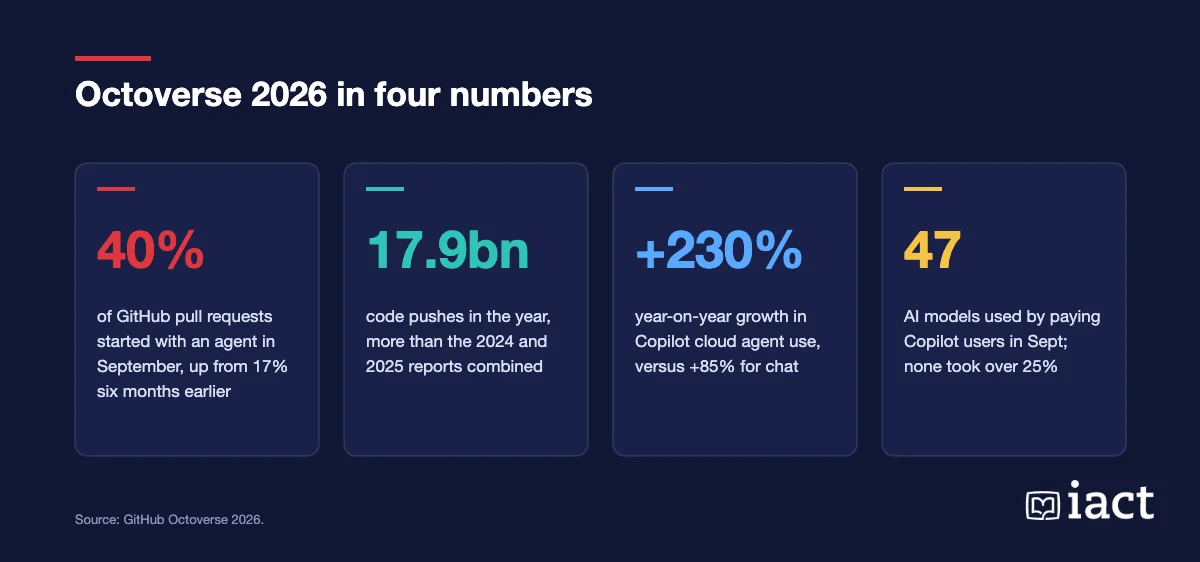
- From asking to delegating. Use of Copilot’s cloud agent grew 230% year on year, against 85% for agent chat. Developers are handing over whole tasks, not just asking questions.
- No single model is winning. Paying Copilot users drew on 47 different models in September, and none handled more than a quarter of requests.
- Let the tool choose. More than 60% of paying Copilot users tried automatic model selection at least once in September, a sign that routing work to the right model is becoming a skill and a product in its own right.
- More code means more checking. AI-assisted code review and GitHub Advanced Security both grew by more than 90%. As output rises, so does demand for AI that double-checks and secures it.
- AI coding is spreading into new industries. Public repositories linked to construction have grown about 17-fold since 2022, and mining-related ones about 65-fold, albeit from a small base.
Software is the first profession to feel it, not the last
Software development has been on the front line of generative AI. It has gained the most from large language models, and it has been changed by them more than any other profession. With more than 200 million developers hosting and collaborating on code there, GitHub sits at the centre of that change.
One surprise of the past year is how many people outside tech now have GitHub accounts. Finance managers, operations leads and small-business owners are “vibe coding” their own fixes to everyday problems.
Yet agents have not made the developer redundant. Many are in more demand than ever, because there is far more code in the world to manage, review and secure. What has changed is the mix of skills employers want. Software is simply the first field where this is visible, and other professions are likely to follow soon.
Build the skills the agent era rewards, with IACT
Whether you want your team to direct AI agents with confidence or to understand the code they produce, IACT has an instructor-led course for it, delivered in Dublin city centre, online or on-site.
AI courses
- AI Coding for Non-Programmers – build working apps and tools by directing AI, no prior coding needed
- AI for Business Managers – decide where AI and agents fit in your organisation, and how to judge the results
- Microsoft Copilot Training – put Copilot to work across Microsoft 365
- The AI Webinar Series – 12 live one-hour sessions, including AI Agents, Vibe Coding and Responsible AI & the EU AI Act
Programming courses
- Introduction to Programming in Python – the language most AI agents write by default
- Introduction to JavaScript – the foundation of modern web apps
- Introduction to C#, Intermediate C# and ASP.NET with C# – for teams building on Microsoft platforms
- Excel Automation with Python – automate the spreadsheets your business runs on
Browse the full range of AI courses and programming courses, or contact IACT to arrange training for your team.
Sources
- GitHub Octoverse 2026, released at GitHub Universe, October 2026
- The Deep View, interview with Tala Karadsheh, GitHub